
Protocol revenue leaders
Spectre Vitals ranks privacy protocols by 30‑day revenue. Nullmask sits on top with $1.03 M, followed by Railgun at $336.1 K and Tornado Cash at $318.2 K.
- Nullmask: $1.03 M revenue (Solana, Ethereum, BSC)
- Railgun: $336.1 K revenue (Ethereum, Arbitrum, Polygon)
- Tornado Cash: $318.2 K revenue (Avalanche, Arbitrum, Gnosis)
- Privacy Cash: $123.2 K revenue
- Veil: $111.9 K revenue
- Privacy Pools: $5,435 revenue
Chain fee collections
Zcash (ZEC) and Monero (XMR) operate as chains, so fees flow to miners rather than a protocol treasury.
- ZEC collected $70.8 K in fees over 30 days
- XMR collected $122.8 K in fees over 30 days
- Fees are not counted as protocol revenue
- Miner earnings remain a small share of total privacy‑related value
Market impact on privacy coins
The concentration of revenue in a few protocols may influence investor perception of privacy ecosystems. While ZEC and XMR still command large market caps, their on‑chain fee income is an order of magnitude lower than protocol earnings.
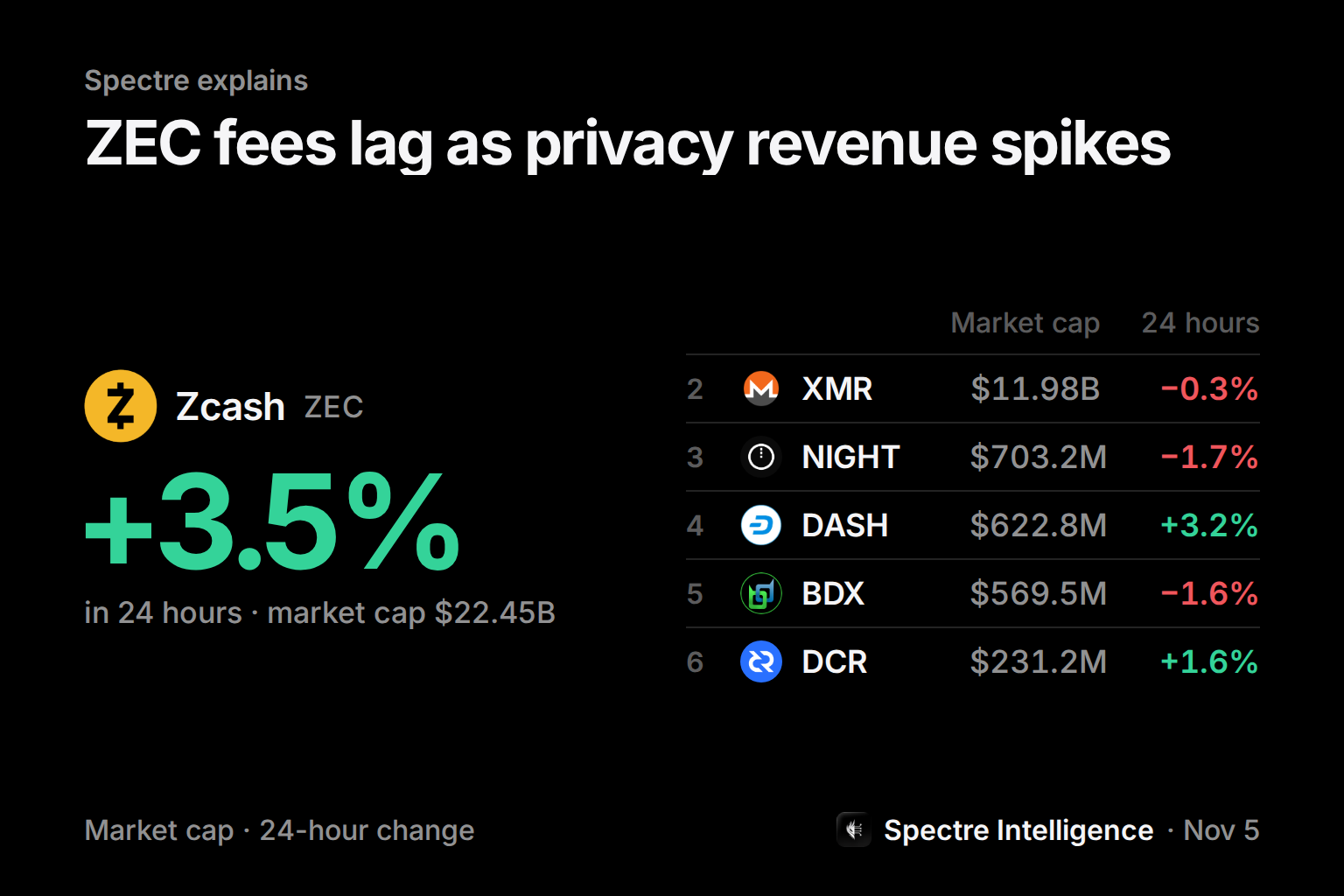
- ZEC market cap $22.45 B, 3.5 % 24‑h rise
- XMR market cap $11.98 B, -0.33 % 24‑h change
- Revenue gap highlights shift toward protocol‑layer services
- Potential reallocation of capital toward high‑revenue protocols
Upcoming developments
Zcash is preparing the NU7 network upgrade, which could affect future fee dynamics. Monitoring how protocol revenue trends interact with chain upgrades will be key.
- NU7 upgrade announced Oct 21 2026 (CoinDesk)
- Upgrade may alter transaction costs and fee flow
- Watch for post‑upgrade fee data on ZEC
- Protocol teams may adjust incentives in response
Live tracker: Crypto market today, today’s numbers, updated through the day.
What to watch
- Nullmask protocol updates
- ZEC NU7 network upgrade rollout
- Monero fee trends
Questions readers ask
What defines a privacy protocol’s revenue?
Revenue is the net amount earned by the protocol from user fees, tokenomics or service charges, distinct from chain‑level transaction fees that go to miners.
Why are ZEC and XMR fees lower than protocol revenues?
Both are base layer chains; their fees are paid to miners and are not captured by a protocol treasury, whereas dedicated privacy protocols collect fees directly.
Can protocol revenue growth influence token valuations?
Higher protocol revenue can signal stronger utility and may attract capital, but token price also depends on broader market sentiment and network effects.
Sources
See a discrepancy? Send the article URL and supporting evidence to spectre@spectreai.io.
Explore Spectre