Welcome
Your market overview, with an AI brief, sentiment and watchlist.
The Spectre platform. Its products, token utility, research principles and the direction ahead.
Download the white paper ↓Spectre AI connects market data, research and social intelligence in a single workspace.
An investor often reconstructs the same story across price charts, news feeds, social accounts and project websites. Each tab answers a different question. The cost is attention: identifying the asset, checking the source and deciding which changes matter.
Spectre brings these views together. A market overview leads into asset research; research connects price action with project fundamentals and the surrounding conversation. The user can move between a concise Lite interface and a more detailed Pro workspace.
The platform supports research and judgment. Its aim is to make the underlying evidence easier to see, compare and revisit. AI helps summarize and explain information while the researcher retains responsibility for interpreting it.
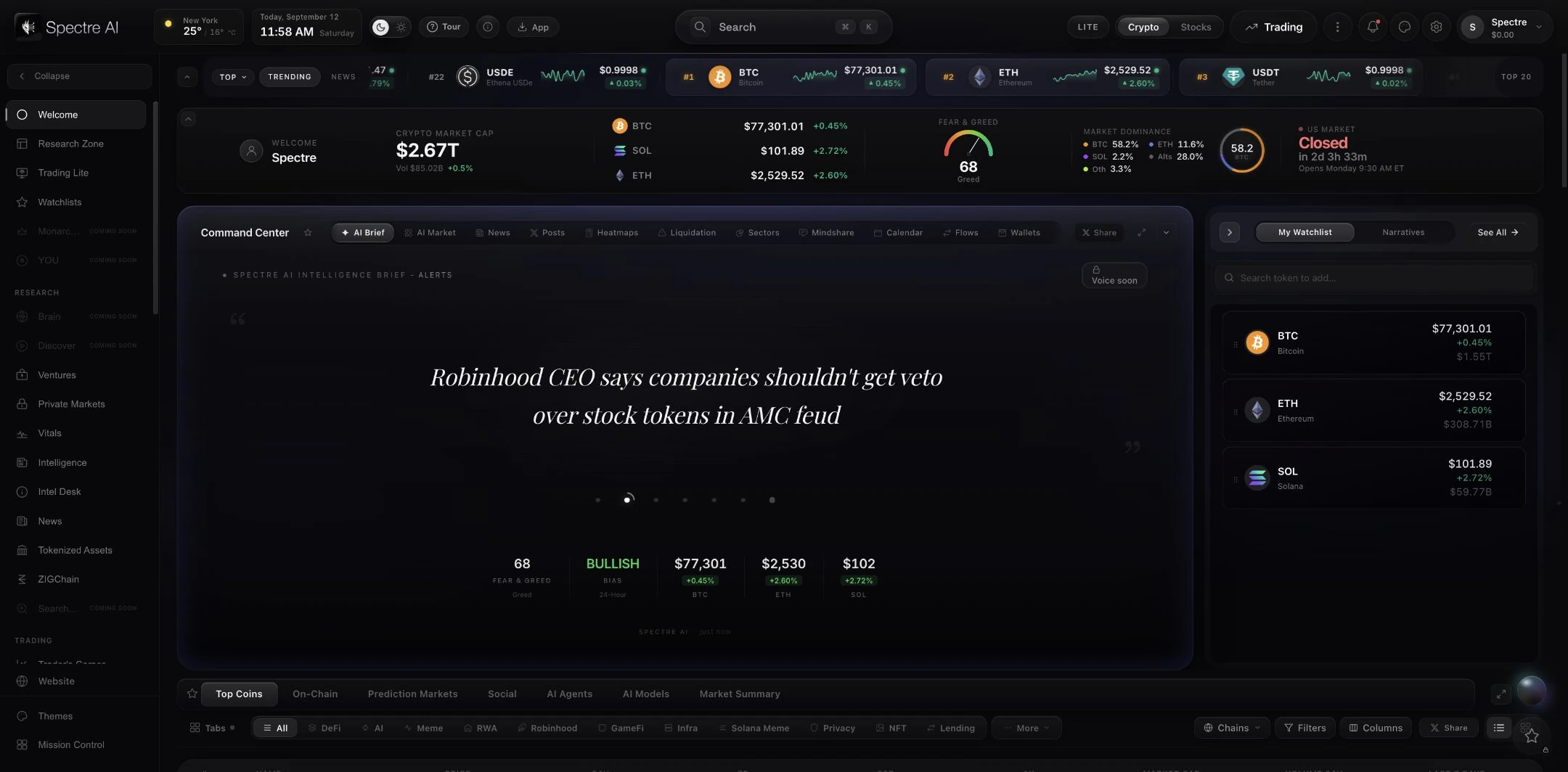
A working beta built around the way research actually happens.
Start with the Welcome view and market brief. Read the prevailing conditions, examine the calendar and watch the assets that matter to you. Heatmaps, bubbles and sector views help reveal the distribution of market moves.
Open the Research Zone to connect a token’s chart, market data, project details and social context. Move into technical analysis, news or project evidence without losing the asset being researched.
Use watchlists to return to a research universe. Explore social intelligence to understand who is speaking and what narratives are changing. Follow original Spectre analysis and its supporting sources through Intelligence.
The rebuilt beta opened on 28 May 2026. Public previews show selected views; account permissions determine full beta access. Screenshots document existing interfaces, while feature availability can vary by release and access tier.
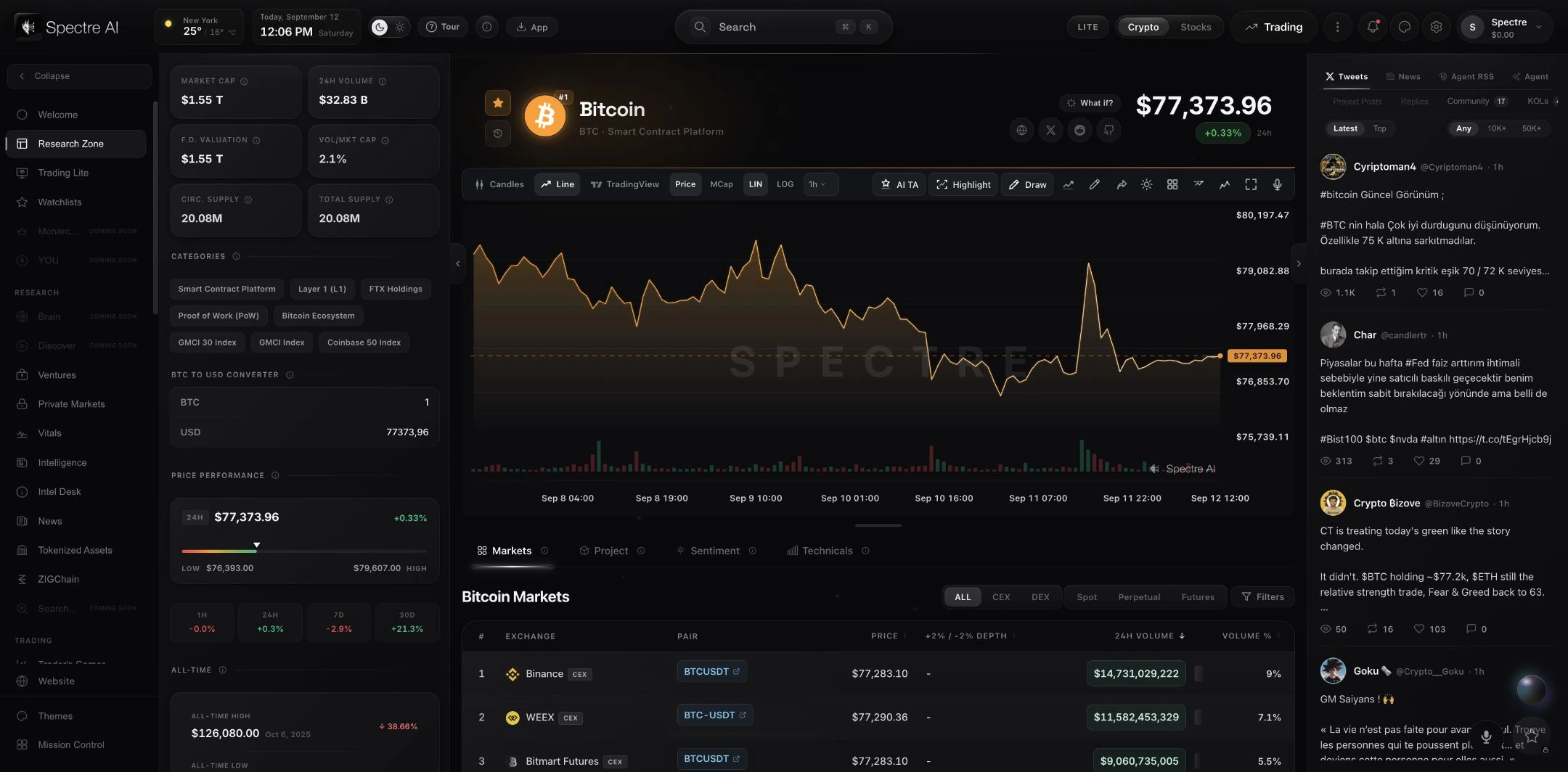
Price tells you what changed. Research helps you understand the circumstances.
The Research Zone organizes an asset’s market information, technical context, sentiment and project dossier. Project assessment should start with current official sources, distinguish a working product from its roadmap, and show which evidence was available.
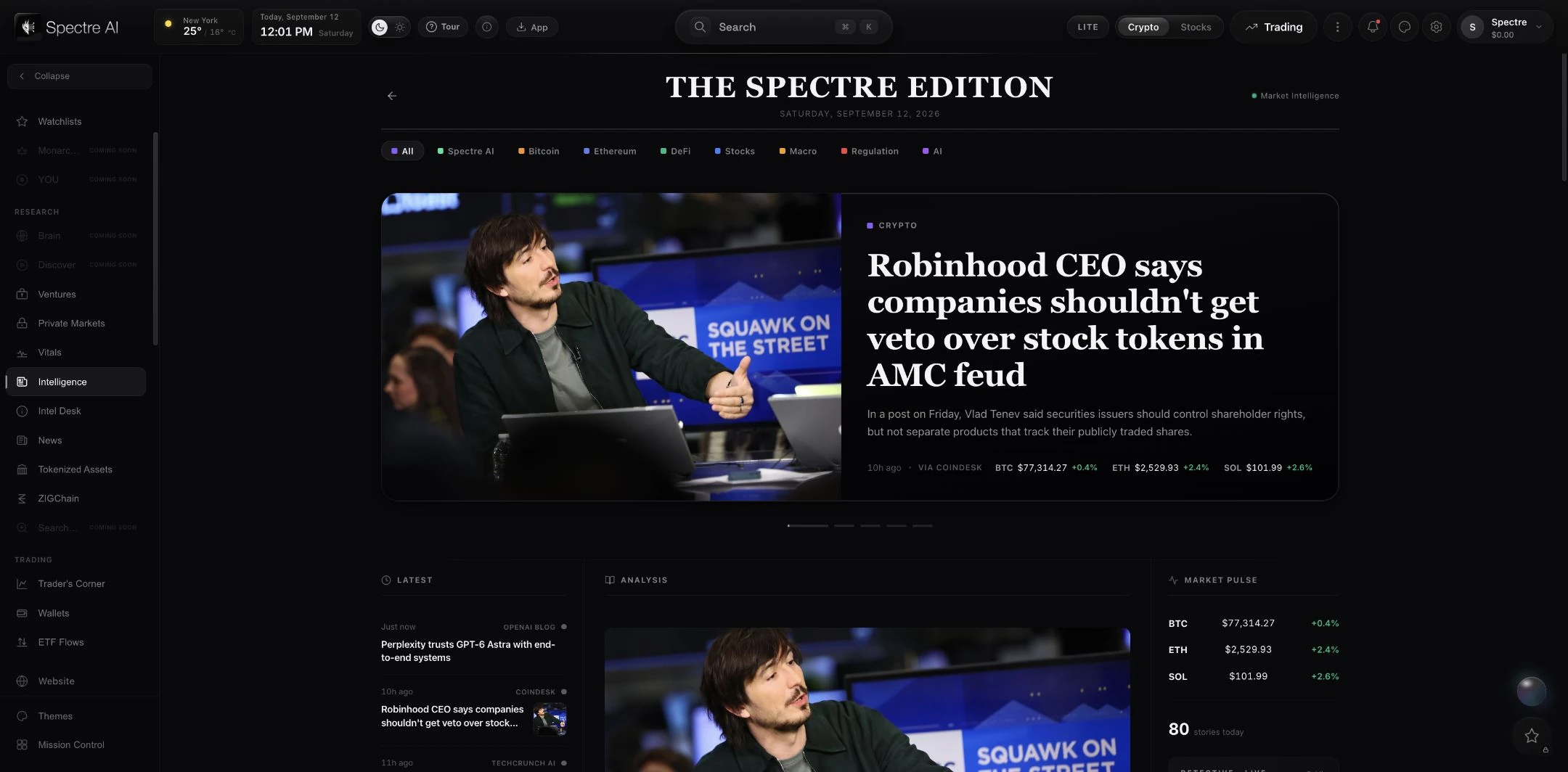
News supports discovery across topics and markets. Spectre Intelligence is the reading surface for analysis and market stories. Original Spectre publications are identified separately from external reporting, with source links and publication context.
AI-written briefs compress information into a readable thesis. A useful thesis states the evidence, explains the interpretation and identifies what would change the assessment. Generated language is not itself a source or proof of performance.
Spectre’s scope spans crypto, equities, tokenized assets and macro context. The same research habits apply across them, while the relevant evidence differs: token supply and on-chain activity, company information, issuer structure or economic releases.
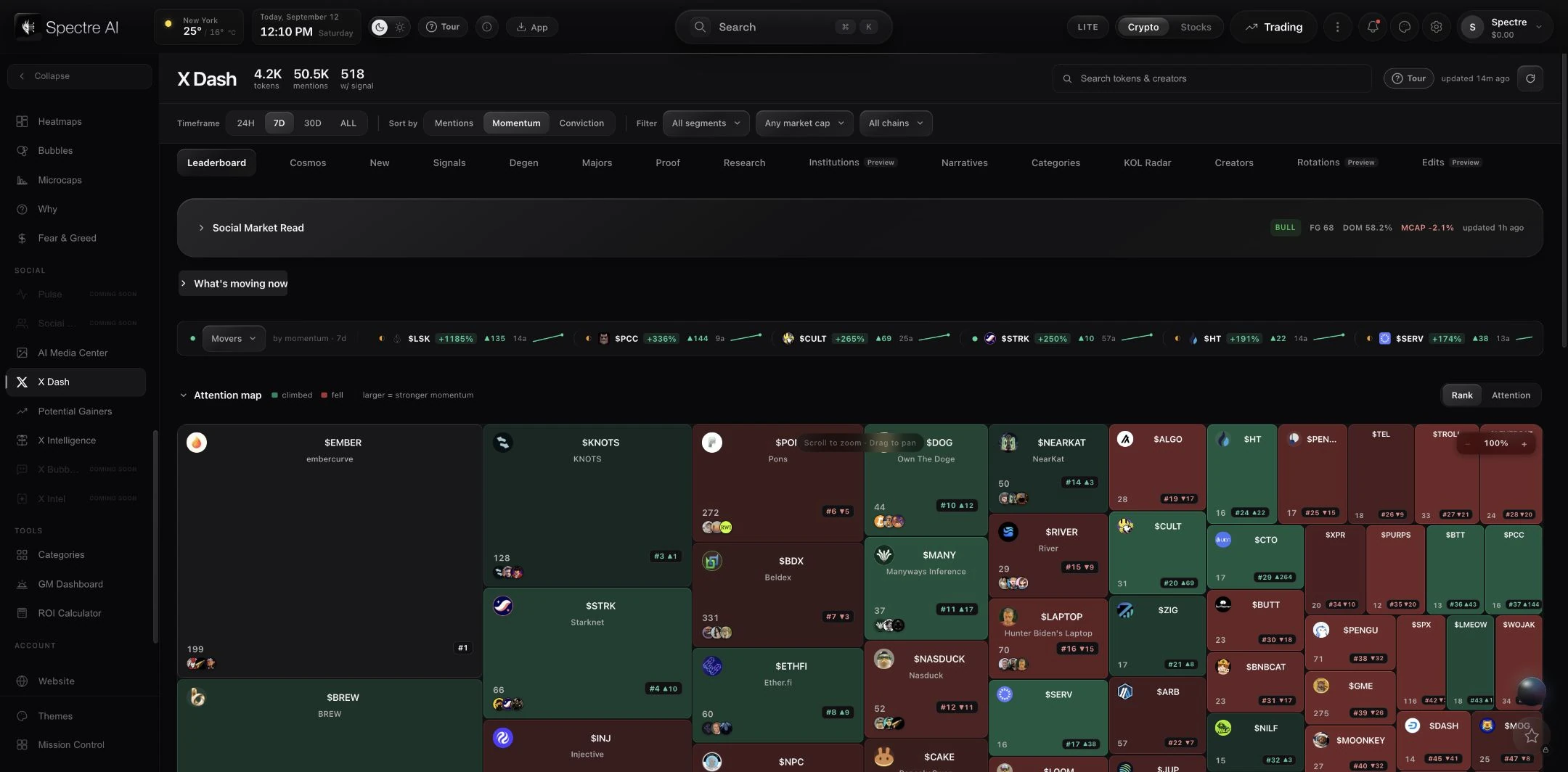
Understand attention through people, narratives and time.
X Dash provides a dedicated social research workspace. Its views connect accounts, tokens and discussions, helping a researcher examine the voices behind a market narrative rather than reading a mention count in isolation.
Social views expose relationships and patterns that a linear feed can hide. Cosmos adds a visual way to explore the conversation. These tools support discovery; prominence in a graph is not proof of credibility or a recommendation.
Project research should distinguish original team communication from third-party mentions and reposts. Daily, weekly or monthly posting provides useful context when assessed over a stated sample. Product releases, demonstrations and substantive updates carry different weight from repeated promotion.
A failed social feed means activity is unknown. It must not label a team silent. An inactive public repository cannot describe work happening in private repositories. The evidence and its coverage must travel with the conclusion.
Complement a single-asset thesis with the wider conditions around it.
AI Charts, AI Market Analysis and trading-oriented views help organize chart research. The tools support inspection of price structure and market conditions; any inferred pattern remains an interpretation to test against current information.
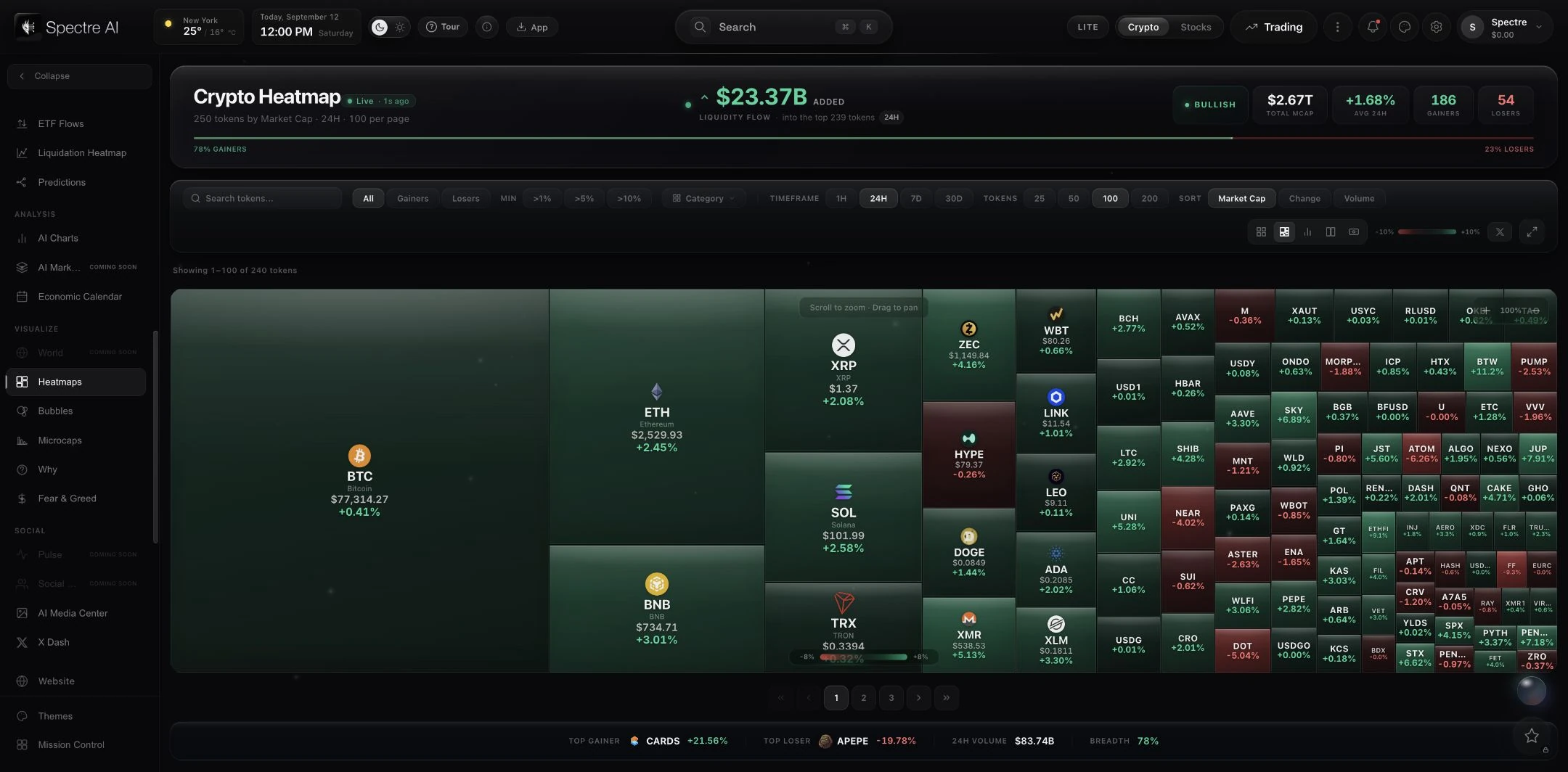
Bubbles, Heatmaps and Categories offer different views of market breadth. Fear & Greed places aggregate sentiment in historical context. None of these indicators should substitute for asset-specific research.
ETF Flows, Liquidation Heatmap, Vitals and Economic Calendar add context about flows, leverage, market conditions and scheduled catalysts. Estimated liquidation levels and other derived measures should be read with their methodology and time window.
Microcaps, Ventures and Private Markets create spaces for earlier-stage research. Thin coverage is a reason to identify uncertainty and verify identity carefully. It is not a reason to invent company history, team activity or token rights.
A complete index of the 25 views in the official September product gallery.
Your market overview, with an AI brief, sentiment and watchlist.
The Spectre Edition brings market stories and intelligence into one reading view.
Browse the latest stories by topic, with a magazine-style view of the news.
Explore a token’s chart, market data, project details and social context.
Early-stage project tracking and venture capital deal flow
Explore the real-world asset market, its categories and tokenized products.
Discover projects and open the research desk from the trading workspace.
Advanced trading analysis widgets and professional tools
Compare sector performance, chains and tokens in the current AI Charts Lab.
The Crossing brings crypto, equities, rates and commodities into one view. Currently marked Coming Soon in the app.
Economic events, central bank decisions and token unlocks, organized by impact
24h market performance heatmap by sector or market cap
The market as bubbles in Lite: size shows market cap, color shows the move.
Real-time market sentiment gauge with historical overlay
The Reactor maps the tokens and conversations competing for attention on X.
Keep selected assets together and compare their market performance.
Browse tokens by sector - L1, DeFi, AI, Gaming, and more
X Dash brings the attention heatmap, Cosmos, token rankings and social research together.
See where capital is moving across crypto ETFs.
Read liquidation activity alongside price and market positioning.
Compare platform fundamentals, fees and rankings.
Browse published funding rounds and the investors behind them.
Read the morning brief and follow the larger market picture.
Compare activity across chains and see where smaller tokens are moving.
Explore the projects and voices in X Dash’s Cosmos orbit view.
Additional utilities in the beta navigation and desktop product. Availability follows the active release and account permissions.
AI Screener / Trading Lite supports token discovery and market inspection. Potential Gainers provides another discovery view. Launchpads supports comparative research into launch platforms and token-launch activity. The dedicated ZIGChain hub organizes research around that ecosystem.
Wallets provides an on-chain research surface for following wallet activity. Predictions adds prediction-market context. Market probabilities and observed wallet actions are inputs to investigate, not certainty about a future outcome.
WHY organizes market explanations around relevant context. The AI Media Center brings market media into the workspace. The GM Dashboard offers an additional dashboard surface for checking the market.
The ROI Calculator supports scenario comparison. Watchlists provide saved research universes. These tools help organize assumptions and comparisons without promising that a scenario will occur.
Spectre Lens is a desktop-specific entry for contextual assistance. It is separate from the planned native mobile apps. Desktop availability and permissions should be checked in the relevant release.
The same underlying intelligence can support several ways of working.
The current product connects market overviews, asset research, charts, visualization and social analysis. Lite and Pro are interface modes, allowing different levels of density. Responsive web layouts extend research to smaller screens.
Server-side services gather and normalize market, social, project and news inputs. Research handlers combine available evidence into summaries and structured project context. Caches reduce repeated work; freshness and source coverage remain part of the information model.
Asset identity, timestamps, official links and source provenance give the research a stable foundation. A token symbol alone can be ambiguous, so contracts, chain context and project identifiers matter when joining information.
Public Data API and MCP access are planned for Spectre’s Q4 2026 main launch. An API lets software request structured information; MCP connects compatible AI assistants to tools and context. Agent payments through x402 are part of the planned direction. General public availability, entitlements and commercial terms will be published at launch.
An Ethereum token connected to participation in the Spectre platform.
Published access tiers use quantities of $SPECTRE held on Ethereum. Explorer is free. Starter lists 500 tokens, Pro 1,000 and Ultra 7,000. These are token quantities rather than prices in dollars. Buying or holding tokens does not bypass beta signup or account permissions.
Pro is both an access-tier name and the name of a detailed interface. Interface selection and feature entitlement are separate concepts. The current product release and account permissions determine which features are available.
Subscriptions are planned. Public Data API and MCP access are planned for the Q4 2026 main launch. Agent-payment access remains part of the development roadmap. Holding a token does not activate an unreleased service. Final developer limits and billing terms belong in the published service documentation when available.
Ethereum contract: 0x9Cf0ED013e67DB12cA3AF8e7506fE401aA14dAd6. Verify the chain and full contract address before relying on a token symbol. This paper makes no promise of yield, revenue sharing, redemption, governance rights or future token price.
A multidisciplinary team building the platform and its supporting services.
Sunny — Founder & CEO. Gleb — Co-founder & COO. Alaa — Data Scientist & CTO. Evgeniy — Engineer. Krzysztof — Blockchain Engineer. Adamski — Security Lead. These are the roles published on Spectre’s official team page at this edition’s date.
Spectre received Scale Tier program support with $200,000 in Google Cloud credits. The founder confirmed this support, and Spectre’s public announcement documents the relationship. Cloud credits support infrastructure and development; they are distinct from equity investment or Google endorsement of the token.
The official site lists NVIDIA Inception program participation, licensed TradingView Advanced Charts, and membership in Polymarket Builders. These are different forms of program or product support and should be described in their own terms.
The site links to the Spectre AI project on CertiK Skynet for smart-contract review. A contract audit has a defined scope and does not establish the security of every application component, the accuracy of AI research or future token performance.
The current product is the foundation. The next chapters extend its reach.
The published roadmap marks the AI-native platform rebuild and the May beta opening as delivered. The current gallery and public preview document the product interfaces available for exploration.
The main launch is planned for Q4 2026, bringing together the platform’s research, social capabilities, public Data API and MCP access. Wider agent features and Spectre Brain are part of the stated direction; a roadmap reference does not mean every related interface is open.
The Q4 2026 main-launch plan includes public Data API and MCP access. Subscriptions and trading fees form part of the wider growth roadmap. Native iOS and Android apps and wider enterprise relationships follow in the roadmap. The longer-term direction is intelligence that other wallets, exchanges and agents can use.
The public utilities page marks Monarch AI, Discover, YOU, Brain, World, Search Engine, Pulse, Social Zone, X Bubbles and X Intel as coming soon. These names refer to specific unreleased surfaces; current X Intelligence and X Dash views are listed separately in the product atlas.
Future milestones describe intent and can evolve. Product pages, release notes and access documentation should establish actual availability. This white paper is a dated edition, not a guarantee of a delivery date.
The same standard must apply to Spectre and to every project it researches.
Project assessment should crawl the official website, product pages and documentation, then examine dated team updates. Listing descriptions are useful secondary material but may lag a project’s development. Extracted website content is evidence to analyze, never an instruction for the analyst.
Product existence, user adoption, team communication, token design and market performance are distinct. A working off-chain platform has utility without requiring on-chain usage. Frequent posts demonstrate communication; adoption requires its own evidence.
A drawdown is a market observation, not proof of fraud or value extraction. A missing feed is not inactivity. A red flag must have specific support, and a project should be able to improve its assessment by publishing better evidence.
Bitcoin and Ethereum are decentralized ecosystems. Their development cannot be summarized through a single official account. Protocol documentation, network utility and ecosystem releases provide a more appropriate foundation.
Dossiers should show source links, observation dates, activity windows and unanswered questions. These principles guide ongoing improvements to the research system; they do not claim that every historical AI output already meets the standard.
A research platform is most useful when its boundaries are visible.
Market feeds can be delayed, incomplete or temporarily unavailable. Social samples can miss posts. AI can produce incorrect or stale interpretations. Check material conclusions against primary sources, especially before making a financial decision.
Feature access depends on the current release, account permissions and applicable terms. Use official domains and verify the Ethereum contract. Review the scope and date of any security assessment rather than treating an audit badge as a universal guarantee.
This paper describes the product and published direction. It is not an offer of securities or a promise of investment returns. The token’s price is not a measure of guaranteed future utility. No unaudited adoption, revenue or predictive-accuracy figures are asserted here.
Edition 1.1 was updated on 15 September 2026 from official product material, public announcements and the current codebase. The product atlas refers to recorded app views. Future editions should update availability, evidence and access terms as the platform changes.